Exercise 3 Chapter 9

Exercise chapter 9. I am a content creator for the Nutella Café in Chicago.

1. Key steps to content audit:

As identified in our text, Social Media for Strategic Communication, by Freberg.

  • Identify all platforms and gather relevant content and metrics on each platform.
  • Identify whether each piece of content was paid, earned, shared, or owned.
  • Provide the context of each piece of content, the url or title.
  • Outline the purpose and execution of the process of this piece of content.
  • Lay out the metrics for said content.
  • Next, action taken, does the content need to be switched up to continue to be more relevant or should it not be used again at all.
  • Then, Details focus on the specifics that need to be changed with the actions recommended.
  • Make future recommendations based on all of this and if similar content should be used or not.

2. 3 content creation recommendations:

  • Be personal in sharing your story of why this business started. I think an intentional tour/ meet the group video could be a huge and fun starter for a company like this. Especially in a place like Chicago, people need a story for your place of business to make sense.
  • Stories, on any platform (Instagram, twitter, facebook) use things that are in your daily “happenings” as content, it is probably the easiest form of content to keep up on and keeps our audience engaged through polls/questions.
  • Lastly, Identify the aesthetic of your brand. Know how you want your content to look before starting new, it is easy to get lost in wanting to post anything and everything, but you need to make sure your voice comes across the same every time you are interacted with by a follower.

Freberg, K. J. (2019). Social media for strategic communication: Creative strategies and research-based applications. Thousand Oaks, CA: SAGE Publications.

Exercise 2 Chapter 7

3. You are programming content to put forth in your content calendar, but you see a trending topic arising in your community. Participating in this trend would be appropriate for you to jump into the conversation. What steps would you want to take before participating in the conversation?

Well as a Gen-zer, I can attest to the importance of participating in trends on popular social medias. Trends can come at inconvenient times too, especially when their relevant to your goals, and you’re already planning things to post with a campaign, but the importance comes from gaining a larger audience in your community. The steps I believe in this situation you should take is to identify how new the trend is, and try to find those trends to join early on because you’re exposure will be higher. With this information be sure that the trend aligns with your brands mission and voice, as long as that it is appropriate you should execute along the lines of your brand. Apply the trend to what specifically would work for you. In the book it says, don’t force a certain writing style, don’t try to copy others so much as to do the same thing, but to be inspired by it and turn it into your own thing. People live for unique takes on things, so I say run with the trend, just do it for your brand not just to participate in the trend. Lastly, I would say before participating in the trend, do your research, make sure that here aren’t hidden messages behind things that could harm your brand. The worst thing you can do is be uneducated in social media, cancel culture is so bad, but it happens, and this is one way you can actively prevent it, research.

Exercise Chapter 5

10 Easy Yet Valuable Design Tips for Social Media Graphic Design

Find an example of a brand or nonprofit of your choice. Evaluate the vanity metrics on its social media sites (Facebook, Instagram, Twitter, and YouTube) and discuss three ways the brand could improve these metrics. Suggest one advanced metric, channel metric, and behavioral metric it would want to track for each platform.

I chose the brand/nonprofit Best Buddies. I think this is a brand that most people know through their high schools or if they know of anyone with a learning disability. Best buddies has 85.2k followers on Instagram, 75.5k likes on facebook and 78k followers, 3.28k subscribers on YouTube, and 33.8k followers on Twitter. All of these being vanity metrics, they gain most of their likes and comments on Instagram. To improve on these metrics I would suggest a more story driven approach to each post about, which they do with some, but people want to get to know to the people featured on this page more than once likely if they have an enticing story. Second, I would suggest more posting about events and getting your community engaged, there is a lack of comments and engagement on posts. Lastly, I would suggest that, even if it is informal, more honest and real interviews or stories should be made. People like to watch things and learn about this community they are following.

Instagram:

  • Advanced metric: Track conversion of followers who attend Best Buddies events.
  • Channel Metric: Track how many views come from the Explore Page.
  • Behavioral metric: Track how influencer impact affects platform interaction.

Facebook

  • Advanced metric: Track how influencers affect the interaction on posts.
  • Channel Metric: Track what causes your audience to react to with the likes and comments and shares.
  • Behavioral metric: Explore the amount of shares and how that might impact your following.

Twitter:

  • Advanced metric: Look at demographics and who interacts.
  • Channel Metric: Track content use, is it interactive or is twitter used for customer service?
  • Behavioral metric: Explore how many RT’s are made over the last year and how to increase that.

YouTube:

  • Advanced metric: Reaction of influence, positive or negative, or stationary?
  • Channel Metric: Track watch time on videos.
  • Behavioral metric: Track how influencer appearance affects views.

Reference for context of advance, channel, and behavioral metrics found in Social media for strategic communication.

Alton, L. (n.d.). Beyond vanity metrics: 4 ways to track how your Tweets are performing. Retrieved April 5, 2021, from https://business.twitter.com/en/blog/4-ways-to-track-how-tweets-are-performing.html

Freberg, K. J. (2019). Social media for strategic communication: Creative strategies and research-based applications. Thousand Oaks, CA: SAGE Publications.
Promote your Small Business

Once your business is up and running, you need to start attracting clients and customers. A marketing plan would be a great way to get started. Search some small business marketing ideas in business similar to your own to get some ideas on how to promote your business most effectively.

I would recommend starting up social media and a webstie so that you have a “hub” to send any potential clients or customers to so that they can learn more information about your product(s) and how to purchase them. A good place to start on a website would be weebly or godaddy.com. These are very functional website builders to help you make it accessable to your customers with ease. Next, you can utilize the website canva.com for free to help you do graphic design based off of tempaltes and the ability to create your own work. This is a great resource to start up your socials!

After completing these businesses processes, you should have a good basis to get started on building up your clientel and spreading the word to start turning some profit! Best of luck to you and your journey. Stop to look around and smell the flowers every once in a while, it goes by quick.

Get Licenses and Permits/Choose your Accounting System

Licenses & Permits: Paperwork is definitely a not so fun part of the process when you start your own business. There are a variety of small business licenses and permits that may apply to your situation, depending on the kind of business you are starting and where you’re located. You will need to research what licenses and permits apply to your business during the start-up process.

Choosing your accounting system: Small businesses run most effectively when there are systems in place. One of the most important systems for a small business is an accounting system. Your system is necessary in order to create and manage your budget, set your rates and prices, conduct business with others, and file your taxes. You can set up your accounting system yourself, or hire an accountant to take away some of the guesswork. If you decide to get started on your own, make sure to consider these things that are important in choosing a software.

Sources: https://www.thebalancesmb.com/starting-a-small-business-4161641

Pick and Register Your Business Name

Your business name plays a huge role in almost every aspect of your business,so you better pick a good one. Make sure to think through all the potential implications as you explore your option and narrow it down to one.

Once you have chosen your name, you need to check if it’s trademarked or currently in use. Then, you will need to register it. A sole proprietor must register their business name with either their state or county clerk. Corporations, LLC’s, or limited partnerships typically register their business name when the formation paperwork is filed.

Don’t forget to register your domain name once you’ve selected your business name.

Here are 12 tips for naming your business:

  1. Avoid hard to spell names
  2. Don’t pick a name that could be limiting as your business grows
  3. Conduct a thorough Internet search
  4. Get the .com domain name
  5. Use a name that conveys some meaning to you or your business
  6. Conduct a trademark search
  7. Conduct a Secretary of State search
  8. Asses if the name is catchy
  9. Get feedback on the name
  10. Make sure the name sounds good when said aloud
  11. Use resources available for brainstorming names
  12. Make sure you are personally happy with that name

Sources: https://www.forbes.com/sites/allbusiness/2016/10/23/12-tips-for-naming-your-startup-business/#6f00d27c904e and https://www.thebalancesmb.com/starting-a-small-business-4161641

Choose a Business Structure

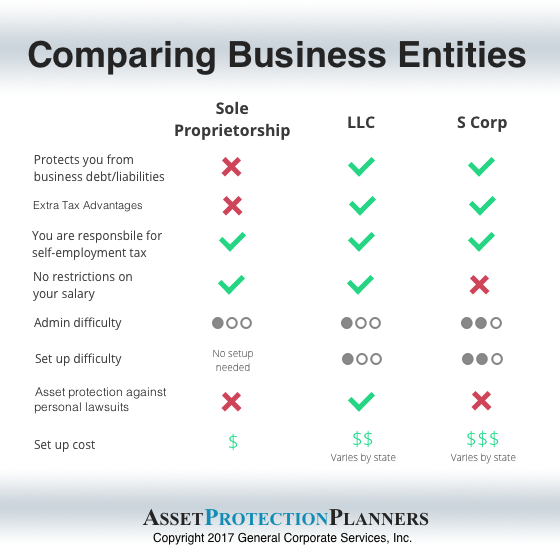
A small business can be a number of structures like a sole proprietorship, a limited liability company (LLC) or a corporation. The entity that you choose will impact things like your business name, your liability, and how you file your taxes.

After choosing your initial business structure, and after you reevaluate you can change your structure as the business grows.

A sole proprietorship costs nothing to establish, but offer no protection whatsoever. Sole proprietorship is when a person does not form a business entity and they operate their business as themselves. In the eyes of the law, you are your business in a sole proprietorship. This can be a risky setup because if your business is sued then you are personally responsible for all of the debts and liabilities. This means your personal assets like your home, cars, and bank accounts are at risk of being used to cover those debts. An advantage through this, is called pass-through taxation. Sole proprietorship income pass this through right to the owner’s individual tax return, this means no corporate tax return and no double taxation. These are also a lot easier to set up and have flexible management.

LLC’s, Limited liability company, are the best business structure for majority of entrepreneurs. You get the best of both worlds between a sole proprietorship and a corporation. It is a legal entity used to run a business or used to hold assets like real estate, boats, or aircraft. The owners of an LLC are called members. An LLC can be owned by 1 person, a single member LLC, or 2 or more people called a Multi-member LLC. An LLC is a business structure, designed specifically to protect your personal assets from the liabilities of the business. An LLC provides liability protection, your personal assets are protected against creditors, offered pass-through taxation and may avoid the double taxation.

A corporation is a legal entity and most often used to run large companies with shareholders. After forming a corporation, you have to elect a board of directors to oversee the company and have to elect corporate officers to execute and run day-to-day business. A corporation is best suited for companies that want to go public on the stock market via an Initial Public Offering (IPO). Corporations are required to hold annual meetings, record all meeting notes and issue shares to the stockholders. A disadvantage of a corporation is the double taxation, the corporation must pay taxes at the federal level and then the owners must pay taxes again on their dividends, on their individual tax returns. The advantage, however, is liability protection, the owners are protected from the debts and liabilities of the business. For an entrepreneur, this would be quite complex and costly to maintain just starting out.

Sources: https://www.llcuniversity.com/llc-vs-sole-proprietorship-vs-corporation/ and https://www.thebalancesmb.com/starting-a-small-business-4161641

Plan Your Finances

Starting a small business doesn’t mean you have to have a lot of money, but any business (mostly) will involve some kind of initial investment as well as the ability to cover ongoing expenses before you are turning a profit.

Put together a spreadsheet that estimates the one-time startup costs for your business. This may include things like licenses and permits, equipment, legal fees, insurance, branding, market research, inventory, trademarking, grand opening events, property leases, and more. Then make another list of things you expect you will need to keep your business running for about 12 months. This includes things like rent, utilities, marketing and advertising, production, supplies, travel expenses, employee salaries, and your own salary, etc.

Those numbers combined is the initial investment you will likely need.

All information found from the author Alyssa Gregory on https://www.thebalancesmb.com.

Making a Plan

A business plan is a critical part of starting a business. It will help guide your business from the start-up phase through establishment and eventually business growth.

The good news is that there are different types of business plans for different types of businesses.

If you intend to seek financial support from an investor or financial institution, a traditional business plan is a must. This type of business plan is generally long and thorough and has a common set of sections that investors and banks look for when they are validating your idea.

But, if you do not anticipate seeking financial support, a simple one-page business plan can give you clarity about what you hope to achieve and how you plan to do it.

Visit https://www.thebalancesmb.com/one-page-business-plan-templates-4135972 for more information on business plans.

Business team meeting present, investor colleagues consultation and conference new strategy plan business and market growth on financial document graph report, Meeting and Talking.

Information from https://www.thebalancesmb.com, author: Alyssa Gregory

Research & Evaluate

If you are thinking about starting a business, its likely you have already identified a business idea, so its time to make it a reality.

First, to evaluate your business idea before taking the plunge you need to look at a few things. Who is going to be your target market?

When looking to identify your target market you should be looking at these key demographic factors that you want to hit: Age, location, income, gender, occupation, education, marital status, ethnicity, and number of children.

“Once your audience has been established, you need to conduct market analysis to determine how big the market is, how saturated it is with competitors, and if there’s room for your product or service.” – Alyssa Gregory

Next, a focus group or a survey would help you learn more about what your target market wants and who they are exactly.

Research your competition: You will discover other businesses are offering similar products or services that are around your target market, but this doesn’t mean your business model will fail. Follow these next 5 steps to help research your competition:

Gather Important Information: After you identify your main competitors, looking at what products or services other business offer and who they are them to would be helpful. Be sure to document their pricing methodologies, positions and branding, and overall market reputation.

Know Which Type of Competition You’re up Against: Does your competition offer the same products to the same clients, known as direct competition, or do they sell different products to different clients, known as indirect competition, or do they offer different products and services to the same clients in the same market, known as substitute competition.

Identify Your Competitive Advantage: By researching your competition, you can identify your own business strength that’s distinctive and can appeal to your target clients.

Conduct a Strengths and Weaknesses Analysis: You should carefully document what makes your competitors strong and what makes them weak. You can do this by searching online reviews, visiting their storefronts, or talking with their customers.

Lastly, Reach Out to Your Competition: This may seem counter intuitive, but by directly communicating with your competition, you can gather important information to help you differentiate your business within the market.

All information found on https://www.thebalancesmb.com from author: Alyssa Gregory

Design a site like this with WordPress.com
Get started